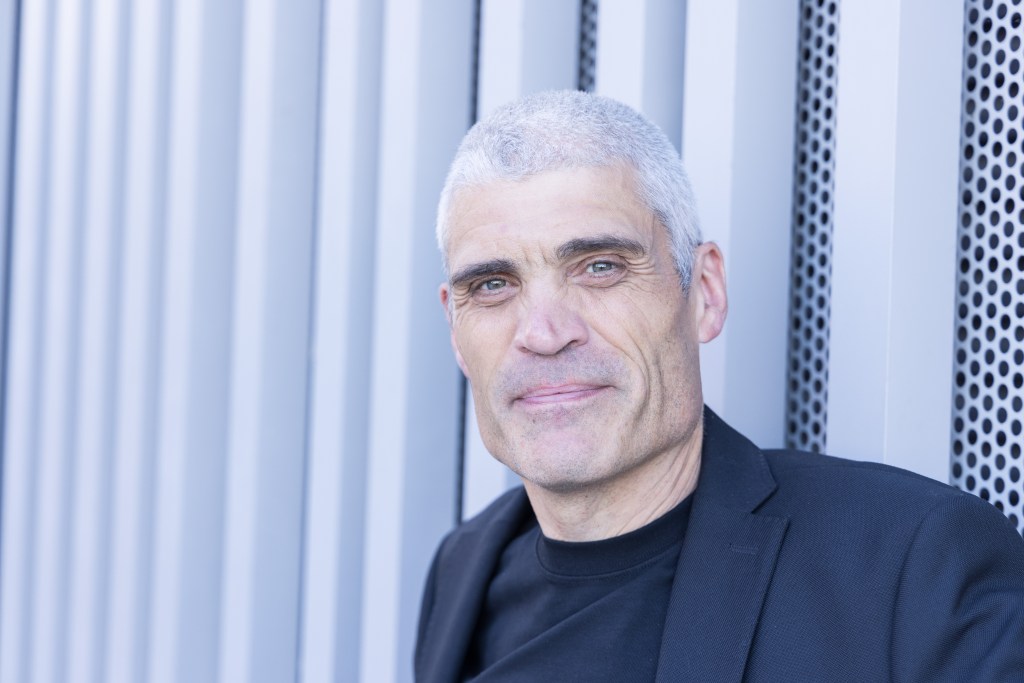
Joan Riera Robusté was born in 1968 in Barcelona (Spain). His father, an architect by profession, and his mother, a philologist, instilled in him a rational and pragmatic mentality on the one hand, and a more artistic, literary, and poetic one on the other. His interest in music and composition began at a very early age, when his parents acquired an electric organ that included lessons with a private teacher. However, in the second lesson he shows the teacher some notes written by himself, asking him to play them. It was already at this early age that he decided to become a composer, an activity to which he would devote his whole life to this day.
During his youth he acquired a very eclectic musical education in different music academies and the private teacher Lluís Vergés, playing both the electric guitar in pop and jazz groups, as well as the cello in chamber ensembles and orchestras. After finishing the high school degree at the age of nineteen, he traveled to the United States to continue his composition studies at Berklee College of Music and The Boston Conservatory, where he had the opportunity to study with Ted Pease, Greg Hopkins, Thomas J. McGah, Phil Willson, and John Adams, among others. Besides composing for Jazz and Big Band groups, he deepens his knowledge of classical music, writing chamber and orchestral pieces heavily influenced by composers such as Debussy, Ravel, Hindemith, and Bartók.
In 2001 he returned to Spain with the certainty of focusing on contemporary classical music and entered the Conservatori Superior de Música de Catalunya, where he studied composition with Helmut Lachenmann, Manuel Hidalgo, John Rahn, Walter Zimmermann, Ramón Lazcano, José Luís Torá, Luca Cori, Eduard Resina and João Pedro Oliveira. At the same time he made an exchange with the Conservatoire Supérieur de Musique de Lyon to study electroacoustic composition, sound editing, and computer programming with Robert Pascal, Denis Lorain, Cristophe Germanique, and François Rouge. During this time he took part in several composition courses in Spain and Europe, including the Schloss Solitude Summer Cours in Stuttgart, or the International Ferienkurse Für Neue Musik in Darmstadt.
Since then, his production includes orchestra and chamber pieces, with or without electronics, and pure electroacoustic works. His music begins to be recognized and programmed in different concerts and festivals in Spain, Europe, and America. In 2003 his piece Estudi de Proporcions 2: Kreise in Kreis for accordion and ensemble was awarded the first prize at the „Concurs Internacional per a Joves Compositors Joan Guinjoan“ (Barcelona), and premiered that same year by the excellent accordionist Oroitz Maiz. In 2005 his piece Estudi de Proporcions 5: Introduction of Purcell’s Diddo and Aaneas, a deconstruction, for violin, cello, and piano, was awarded the first prize at the international competition „City-Sound-Silence“ in Dresden, Germany.
The style of his works from 2001 to 2009 fluctuates between German musical aesthetics, very rational and incorporating noise from extended instrumental techniques, and other aesthetics such as that of the Italian composers Sciarrino or Nono, or the Hungarian composer Ligeti, more focused on deepening the harmonic and timbre richness of traditional musical notes. Nevertheless, his works show an intuitive and impulsive personality, qualities that will be imposed progressively throughout his career as his main creative germs, limiting rational thinking to a few and very specific structural aspects of the works.
Since 2009 his main compositional interest has focused on exploring the possibilities offered by space in relation to the perception of sound. This search forces him to get rid of learned aesthetics in order to find new sound realities where space is the protagonist. Thanks to the University of Aveiro and the confidence of Professor João Pedro Oliveira, he was able to complete a doctoral thesis in which he developed various compositional techniques based on the fragmentation and spatialisation of sine waves. The content of this doctoral thesis entitled Spatial Hearing and Sound Perception in Musical Composition was later published in the journal Organized Sound under the title Filling Sound with Space: An Elementary Approach to Sound Spatialization.
In the couse of this long and profound research he composed three electroacoustic pieces, Topos (2012), Polyphonic Continuum (2013), and Musical Situation 1 (2014), in which he incorporates the distortions produced by the acoustic space, the auditory system, and the body, to manipulate the perception of sound at micro-temporal scales. Moreover, these technique allows the creation of the so-called „diffuse sound fields“ in spaces with very low levels of reverberation. This aspect of his research interested him specially, as diffuse sound fields are very difficult to be perceived in natural even artificial environments, and he will try to further explore this idea later in his career.
His instrumental pieces from 2013 to the present day also aim to find formulas to relate the movement of sound in space to the perception of sound, as well as to emphasize the interaction of sound with the resonances created by architectural spaces. The techniques of fragmentation and spatialization he uses in Pieza para 4 guitarras (y espacio) (2017), as well as in the pieces for orchestra Towards an Isotrophic Sound (a trilogy) (2019, 2023 and 2024), imitate, or rather recreate, acoustic phenomena such as echo or reverberation, which allow him to achieve certain novel and suggestive sonorities and textures.
This approach to architectural music evokes in him a strong affinity with John Cage and minimalist and avant-garde composers such as Steve Reich, Rhys Chatham or Lamonte Young, as well as the sound artist Bernahrd Leitner. After many years of telling sounds what to do, he now feels the need to observe what they are capable of doing on their own. The so-called “feedback” pieces introduce electronics to loop the sounds played by the performers, while propagating them in space through eight loudspeakers placed around the audience. This reverberation-like effect allows the sounds to meet, interact, enrich and transform each other. At the end of some pieces, listeners and performers are asked to sing to themselves the notes they hear very softly, just to provoke a vibration of the body that matches the vibration of the air around them. For him, the act of listening is increasingly driven by the desire to enter into a relationship with the world around him and to merge with it as much as possible.
His most recent activity is dedicated to the project Walls of Sound, in which he incorporates his compositional techniques in architectural spaces with high levels of reverberation, such as chapels and churches. Through these kind of spaces it is possible to further investigate the possibility to reach full diffuse sound fileds. The aim is to create a type of musical composition that could be described as contextual, that is to say, linked to a particular acoustic context. The musical composition thus becomes a meeting point between the emitted sound and the reflected sound, in the hope that from this union emerges what he most craves as a composer: to experience the incomprehensible unforeseen.
In 2017, together with his colleague Christian Vogl, he founded auch Musik, an association dedicated to broadcasting multi-channel electroacoustic music in cinemas in Regensburg using Dolby 5.1 and 7.1 systems.
 joan riera robusté composer
Hinterlasse einen Kommentar